

New research reveals the TM technique to be most effective
A new scientific research study conducted at the University of Kentucky College of Medicine provides further evidence that people with high blood pressure can find relief through meditation—but the study also found that not all forms of meditation are equally effective. The study compared findings from research on several well-known types of meditation and relaxation practices, and found that the only mind/body practice that produces significant changes in blood pressure is the Transcendental Meditation technique.
According to a definitive new meta-analysis of 107 previous studies on stress reduction programs and high blood pressure, published in the American Journal of Hypertension (Vol. 21, 3: 310-316), the Transcendental Meditation technique was found to produce a statistically significant reduction in high blood pressure—an effect not found with other forms of relaxation, meditation, biofeedback or stress management.
Significant Reductions in Blood Pressure
The new meta-analysis reviewed randomized, controlled trials published in peer-reviewed scientific journals over the past decades concerning stress reduction and relaxation methods used by participants with high blood pressure. Blood pressure changes through the Transcendental Meditation technique included average reductions of 5.0 points of systolic and 2.8 points of diastolic blood pressure, changes which were statistically significant, according to the review. These changes associated with Transcendental Meditation practice were consistent with other controlled studies showing reductions in cardiovascular risk factors, improved markers of heart disease, and reduced mortality rates among participants in the Transcendental Meditation program.
Transcendental Meditation technique “equivalent to adding a second hypertensive agent”
"The magnitude of the changes in blood pressure with the Transcendental Meditation technique are at least as great as the changes found with major changes in diet or exercise that doctors often recommend," said Dr. James Anderson, principal author of the study. "Yet the Transcendental Meditation technique does not require changes in lifestyle. Thus many patients with mild hypertension or prehypertension may be able to avoid the need to take blood pressure medications—all of which have adverse side effects. Individuals with more severe forms of hypertension may be able to reduce the number or dosages of their BP medications under the guidance of their doctor.”
Dr. Anderson stated further: “Adding Transcendental Meditation is about equivalent to adding a second hypertensive agent to one's current regiment, only safer and less troublesome.”
Reduced Risk of Heart Attack and Stroke
Anderson added that long-term changes in blood pressure of this magnitude are associated with at least a 15 percent reduction in rates of heart attack and stroke. "This is important to everyone because cardiovascular disease is the number one cause of death in the U.S. and worldwide," Anderson said. The study's biostatistician, Maxwell Rainforth, assistant professor of Physiology and Health Statistics at Maharishi University of Management, said the meta-analysis used state-of-the-art statistical methods to review 107 published studies in the field of stress reduction, relaxation and blood pressure. "The twenty-three separate studies included in the final analysis met well-known criteria for high scientific quality. That is, these studies used repeated blood pressure measurements and participants were randomized to either a stress reduction technique or placebo-type control for at least eight weeks. The data we used are all published in peer-reviewed scientific journals," Rainforth said.
Side Benefits of TM vs. side effects of drugs
According to Dr. Robert Schneider, director of the Institute of Natural Medicine and Prevention and co-author, this rigorously conducted meta-analysis indicates that the Transcendental Meditation technique is distinctively effective compared to other scientifically studied techniques in lowering high blood pressure. "For those 100 million Americans with elevated blood pressure, here is a scientifically documented, yet simple and easy way to lower blood pressure without drugs and harmful side effects. In addition, related studies show an integrated set of positive 'side benefits,' such as reduced stress, reduced heart disease levels and longer lifespan with this technique to restore balance in the cardiovascular system, mind and body," Schneider said.
Overturns a previous study on meditation
The new meta-analysis was co-authored by researchers at the University of Kentucky College of Medicine, in Louisville, and at the NIH-funded Institute of Natural Medicine and Prevention at Maharishi University of Management in Iowa.
According to Dr. Anderson, the findings of this new study rebut a July 2007 report sponsored by the Agency for Healthcare Research and Quality and the NIH-National Center for Complementary and Alternative Medicine, which concluded that most research on meditation is low quality and found little evidence that any specific stress reduction effectively lowers blood pressure.
The new meta-analysis identified all high quality meditation studies published through 2006 and rigorously analyzed their results, which the previous government report failed to do. Anderson said the new meta-analysis includes only high quality studies on all available stress reduction interventions. The studies on the Transcendental Meditation technique were conducted at five independent universities and medical institutions, and the majority of them were funded by competitive grants from the National Institutes of Health.
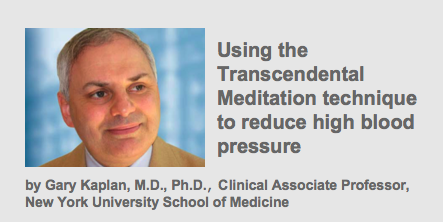
Gary P. Kaplan, M.D., Ph.D., is a neurologist and associate professor of clinical neurology at New York University School of Medicine.
According to a definitive new meta-analysis of 107 previous studies on stress reduction programs and high blood pressure, published in the American Journal of Hypertension (Vol. 21, 3: 310-316), the Transcendental Meditation technique was found to produce a statistically significant reduction in high blood pressure—an effect not found with other forms of relaxation, meditation, biofeedback or stress management.
Significant Reductions in Blood Pressure
The new meta-analysis reviewed randomized, controlled trials published in peer-reviewed scientific journals over the past decades concerning stress reduction and relaxation methods used by participants with high blood pressure. Blood pressure changes through the Transcendental Meditation technique included average reductions of 5.0 points of systolic and 2.8 points of diastolic blood pressure, changes which were statistically significant, according to the review. These changes associated with Transcendental Meditation practice were consistent with other controlled studies showing reductions in cardiovascular risk factors, improved markers of heart disease, and reduced mortality rates among participants in the Transcendental Meditation program.
Transcendental Meditation technique “equivalent to adding a second hypertensive agent”
"The magnitude of the changes in blood pressure with the Transcendental Meditation technique are at least as great as the changes found with major changes in diet or exercise that doctors often recommend," said Dr. James Anderson, principal author of the study. "Yet the Transcendental Meditation technique does not require changes in lifestyle. Thus many patients with mild hypertension or prehypertension may be able to avoid the need to take blood pressure medications—all of which have adverse side effects. Individuals with more severe forms of hypertension may be able to reduce the number or dosages of their BP medications under the guidance of their doctor.”
Dr. Anderson stated further: “Adding Transcendental Meditation is about equivalent to adding a second hypertensive agent to one's current regiment, only safer and less troublesome.”
Reduced Risk of Heart Attack and Stroke
Anderson added that long-term changes in blood pressure of this magnitude are associated with at least a 15 percent reduction in rates of heart attack and stroke. "This is important to everyone because cardiovascular disease is the number one cause of death in the U.S. and worldwide," Anderson said. The study's biostatistician, Maxwell Rainforth, assistant professor of Physiology and Health Statistics at Maharishi University of Management, said the meta-analysis used state-of-the-art statistical methods to review 107 published studies in the field of stress reduction, relaxation and blood pressure. "The twenty-three separate studies included in the final analysis met well-known criteria for high scientific quality. That is, these studies used repeated blood pressure measurements and participants were randomized to either a stress reduction technique or placebo-type control for at least eight weeks. The data we used are all published in peer-reviewed scientific journals," Rainforth said.
Side Benefits of TM vs. side effects of drugs
According to Dr. Robert Schneider, director of the Institute of Natural Medicine and Prevention and co-author, this rigorously conducted meta-analysis indicates that the Transcendental Meditation technique is distinctively effective compared to other scientifically studied techniques in lowering high blood pressure. "For those 100 million Americans with elevated blood pressure, here is a scientifically documented, yet simple and easy way to lower blood pressure without drugs and harmful side effects. In addition, related studies show an integrated set of positive 'side benefits,' such as reduced stress, reduced heart disease levels and longer lifespan with this technique to restore balance in the cardiovascular system, mind and body," Schneider said.
Overturns a previous study on meditation
The new meta-analysis was co-authored by researchers at the University of Kentucky College of Medicine, in Louisville, and at the NIH-funded Institute of Natural Medicine and Prevention at Maharishi University of Management in Iowa.
According to Dr. Anderson, the findings of this new study rebut a July 2007 report sponsored by the Agency for Healthcare Research and Quality and the NIH-National Center for Complementary and Alternative Medicine, which concluded that most research on meditation is low quality and found little evidence that any specific stress reduction effectively lowers blood pressure.
The new meta-analysis identified all high quality meditation studies published through 2006 and rigorously analyzed their results, which the previous government report failed to do. Anderson said the new meta-analysis includes only high quality studies on all available stress reduction interventions. The studies on the Transcendental Meditation technique were conducted at five independent universities and medical institutions, and the majority of them were funded by competitive grants from the National Institutes of Health.
Gary P. Kaplan, M.D., Ph.D., is a neurologist and associate professor of clinical neurology at New York University School of Medicine.


 Posts
Posts

